Search Mas Republic

Showing posts with label Caribbean. Show all posts

Wednesday, 11 September 2013

BBC News - The Afro comb and the politics of hair: Audio slideshow

BBC News - The Afro comb and the politics of hair: Audio slideshow
The Afro comb has been used by people in Africa and the continent's diaspora for centuries.
An exhibition at the University of Cambridge's Fitzwilliam Museum looks at the Afro comb's impact as both a hair care tool and cultural symbol over the last 6,000 years. It takes visitors on a journey that looks at ancient Egypt, the US civil rights movement and communities across Africa and the Caribbean. Take a brief tour with exhibition curator Sally-Ann Ashton.
Enhanced by Zemanta

Saturday, 16 February 2013

BABY DOLLS OF NEW ORLEANS

In Trinidad and Tobago Carnival there is a traditional  mas character called 'baby doll'. Born of of the carnivals of the 1930's the baby doll masquerader will walk around with a doll, that represented an illegitimate child and accuse men on the street of being the babies father and demand money.

I just came across an article on a character in the united States that pre dates Trinidad's character of the 1930's also called 'Baby Doll' very interesting indeed.
check it out.

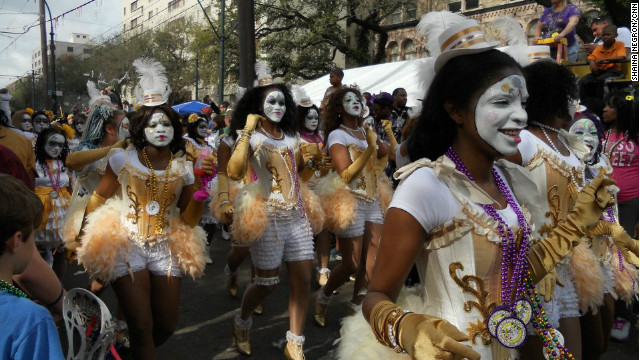
The New Orleans Baby Doll Ladies march in the Zulu parade during Mardi Gras 2012


A modern celebration of African-American history

CNN) -- The week before Hurricane Katrina hit New Orleans in 2005, Millisia White came back to her native city on a trip for work. She stayed behind to help her family recover and has been home ever since.
There was something she felt she had to do. "When something you are so familiar with is threatened to be lost forever, you cling to what's familiar," said White, who moved back from Atlanta.
For White and her brother, that meant bringing back a century-old New Orleans practice of masking, or masquerading, which was nearly vanishing.
That year, she founded the New Orleans Society of Dance and incorporated into the dance company a cultural legacy series of dance performance that would revive tradition of the Baby Dolls -- with a modern twist.
"We wanted to do something representing this tradition and what it meant and symbolize it in some form."

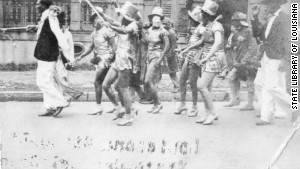
In a photo from the State Library of Louisiana, women wear Baby Doll-style costumes in a 1930s street parade.
The Baby Doll practice started about 1912, when groups of women in New Orleans' red light district poked fun at society's stereotypes of women by marching in street parades dressed as dolls. It grew into a tradition centered on dance and paired with jazz bands of the popular music of the era.
Groups of women embraced the attitude of freedom and the pageantry of the Baby Doll street parades, but their focus grew over the decades. They organized and began serving their community through groups called "social aid and pleasure clubs."
"These were just people who were very much of their community," said Karen Leathem, a historian with the Louisiana State Museum. "They tried to help their neighbors during an era of segregation and limited opportunity for all people of color."
However, by the 1980s and 1990s, only a handful of groups were masking as Baby Dolls.
Several neighborhood groups like the Million Dollar Baby Dolls and the Ernie K-Doe Baby Dolls were active in the new millennium. But by 2005, the Baby Doll practice seemed as if it was about to be forgotten in Katrina's wake.
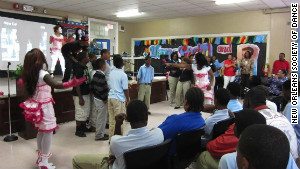
The Baby Doll Ladies with DJ Hektik dance with students at the McDonogh 42 Charter School in
 spring 2011.
"My brother and I decided, we needed a sort of campaign," White remembered. "It all started so we could give something back in our own backyard."
She had heard about the Baby Doll tradition as a child and felt that it was a medium close to her heart. "It's synonymous with dance and with women," she said.
White's revival produced the Baby Doll Ladies, with costumes, face paint, music and dances that are modern takes on the Baby Dolls of the past. Rather than using a live band, her brother DJ Hektik plays mixes of hip-hop and jazz for their choreographed performances.
But White also wanted to bring back the community focus central to the Baby Doll tradition.

Enhanced by Zemanta

Thursday, 4 October 2012

Final farewell for 9-time Carnival King Vieira


send-off:
Family members of nine-time King of Carnival Geraldo Vieira bear his casket after yesterday's
funeral service at St Theresa's RC Church in Barataria. —Photo: CURTIS CHASE
While the achievements of masman Geraldo Vieira were being extolled inside St Theresa's Roman Catholic Church, Malick, Barataria, yesterday, on the outside several of his lifelong friends were sharing stories of the man who they say loved life, his family, Carnival and having a good time.
And although tears flowed for the former nine-time King of Carnival there was a lot of laughter as his colleagues remembered how he made them laugh back in their youth.
Vieira succumbed to heart failure on September 22, leaving behind what many in the Carnival fraternity believe is a great legacy of mas production and presentation.
He was an innovator who while preserving the almost lost traditional crafts and skills involved in creating mas costumes, incorporated into his creations the latest in digital technology to enhance whatever he was portraying.
That, said National Carnival Bands Association (NCBA) president David Lopez, was what always kept Vieira ahead in the art form.
The mas fraternity came out in their numbers to say farewell to Vieira, packing the church to capacity and spilling out to the courtyard.
At the entrance to the church there was a large flat-screen television with photographs of Vieira from his youth to not long before his passing. Also shown were images of the costumes, both kings and queens, he designed and built over the years.
Vieira was born in Barataria in 1938 and grew up with a passion for Carnival arts and the creation of form and structure. In 1959 he began his mas-making career in earnest, learning how to do wire bending and other craft from renowned masman Cito Valesquez.
They produced the band titled Fruits and Flowers that year, with Valesquez doing the fruits and Vieira creating the flowers.
A master structural engineer and very inventive designer, Vieira went on to work with other Carnival greats including Harold Saldenah, Hilton Cox, Stephen Lee Heung, Peter Minshall and Wayne Berkley.
Along with masmen with whom Vieira had worked and played with since his youth, the funeral was attended by members of the NCBA executive, of which Vieira was a part up to the time of his passing.
Also paying respects was former minister of culture Joan Yuille Williams, Minister of The Arts and Multiculturalism Lincoln Douglas and bandleaders Brian MacFarlane, Rosalind Gabriel, Trevor Wallace and artist/calypsonian Bill Trotman.

By Wayne Bowmanwayne.bowman@trinidadexpress.com 


Enhanced by Zemanta

Wednesday, 29 August 2012

Europe's 'Biggest Street Festival' Rocks London


By Selah Hennessy

LONDON — During a summer dominated by the Olympics, Europe's largest street festival, the Notting Hill Carnival, gave London revelers another thing to smile about Sunday and Monday. The carnival is an important cultural event led by the West Indian community in London. 

About 1 million people poured onto the streets of west London during the two days of the Notting Hill Carnival.  Swamped on all sides by massive crowds, hundreds of groups took part in the parade, dancing to the beat of pounding music that pumped through loudspeakers.   

Their costumes ranged from the colorful and extravagant to the surprising and surreal.  The members of a group called "Chocolate Nation" arrived splattered head to foot in melted chocolate.

VOA accompanied one band, called Jamboulay Carnival Arts, along the route.  It is run by Francesca Bailey, who said getting ready for Carnival takes her the whole year.

She has to raise the money, around $10,000, to run workshops, build a float, and get the costumes ready.  But she says she does it to keep her culture alive.

"We do it every year because for us it is a very cultural thing, and it is important that we continue with our culture.  Carnival is something that began many years ago in Trinidad and Tobago, and it was based on the emancipation of slavery and it has over the years, it has progressed and evolved.  So, it is nice to see that it has come to Britain and really evolved over the years," Bailey said.

The first day of the carnival, Sunday, is dubbed "Family Day" and is especially for young people.

One of Bailey's sons, 17-year-old Bami Bailey, has been coming to the Carnival with his mother since he was a small child.  He told VOA it has been an important relief from his day-to-day life.

"A lot of us "black kids," shall I say, we live in London ... we live in not poverty, but we live in the bad, terrible areas.  And just a place full of crime and stuff like that.  And carnival is a place where you are always happy, you get a good feeling and everything," Bailey said.

Notting Hill Carnival originated about five decades ago, in part to improve race relations in London.  It is led by the West Indian community, but also incorporates communities from all over the world.  

Participants raise money from various organizations, including local councils, and much of the work is done voluntarily.

Tailor Thomas Benjamin, who is originally from Trinidad and Tobago, has been volunteering his services for the past 10 years, helping to make costumes for the Carnival.  He says he does it to help young people.

"If we are able to reach children before they are exposed to negative things then you save one child from going to jail, you save one child from being in the grave.  The minute the youth, he reaches 14, 15, 16, if he does not have a Carnival background, if he did not have something positive to turn to, then most of the time it is a dead-end situation," Benjamin said.

He says it is an important diversion for young people in his borough, Hackney, one of a number of London neighborhoods that was rocked by riots last year; vehicles and buildings were set on fire and shops across the city were looted.
Enhanced by Zemanta

Friday, 27 July 2012

Celebrating Carnival at the ROM


Carnival is a pre-lent festive season that is celebrated around the world, but especially in Trinidad and Tobago and on other Caribbean isles, where the event culminates in giant parades the day before Ash Wednesday. Traditionally, participants in those parades wear elaborate, colourful costumes, like Mac Farlane’s.
Opening to the public on Saturday, “Carnival: From Emancipation to Celebration” features a gallery of sketches of Mac Farlane’s thematic designs over the past three years. Since beginning his career as a teenager in the early 1970s, Mac Farlane has won numerous awards for his Carnival work in Trinidad and Tobago and has been tapped to provide presentations for international events like this year’s Olympics. Looking at the sketches, one can see why his work has earned such prestige. His designs are attention-grabbing, and layered with symbolism.
Sketch by Brian Mac Farlane for Aphotic costumes, 2012. According to the interpretive notes, these outfits project "a sense of hopelessness and despair" that people feel when they are "rendered powerless by the negativity that surrounds them.

Take the “Sanctification…In Search Of” series of outfits Mac Farlane produced this year. According to his website, the designs came about as a result of his pain “at the inhumane way in which we treat each other.” Headline after headline regarding crime, the worsening economy, and the fraying of the social fabric led Mac Farlane to create a series of costumes employing the colours of Trinidad and Tobago’s flag: “Red represents our blood; Black represents the darkness, in which we currently find ourselves; and White represents cohesiveness and unity that form part of the solution.” The result is outfits that range from demonic figures draped in blood and darkness, to lighter figures embodying patriotism—which seems appropriate given this year’s celebration of the golden anniversary of Trinidad and Tobago’s independence from Great Britain.
Besides Mac Farlane’s work, the gallery also features images from the past 45 years of Toronto’s Carnival celebrations (though don’t go looking for any reference to the festival’s former name, which the organizers are now legally prohibited from using). Video clips include thoughts from the likes of Toronto Raptor Jamaal Magloire on the meaning of the celebration. One drawback to the exhibit is how it’s split up. It’s unfortunate that Mac Farlane’s costumes are one floor away from the sketches they grew from. Rather than being almost hidden away in a corner, the full-size outfits could have formed a focal point in the centre of the exhibit’s main second-floor gallery.
Photos by Jamie Bradburn/Torontoist.
Carnival: From Emancipation to Celebration
Royal Ontario Museum (100 Queen’s Park)
July 28, 2012 through February 24, 2013
$15 adults, $13.50 students and seniors (part of regular admission


Enhanced by Zemanta

Thursday, 22 March 2012

Carnival designer to host pre World Party in the Park Popley workshops

LEADING Notting Hill Carnival designer Clary Salandy will soon be in town as part of preparation for this year’s World Party in the Park. Craft education charity The Making has arranged for Trinidad-born Clary to come to Popley to introduce Mas-making or Masquerade to Basingstoke families.

Some of Clary's work.
 Copyright image by Mahogany
 
 Her free Caribbean Carnival workshops will take place at the Popley Spotlight Centre during the Easter and summer half-term holidays. The families will make sculptures and costumes to be worn at the Children’s Parade in Eastrop Park on June 30. Clary said: “Carnival grew out of slavery and protest, and is a legacy passed on to people like me.” Her parents took part in carnivals in Trinidad, and her father before her made carnival costumes when he was young. Today, Clary’s costumes are legendary throughout the world. She continued: “I want to take spectators’ breath away! It’s all about impact and affirmation, bringing the world of imagination to life. It should be awe-inspiring. “I create costumes that have inherent movement, but at the end of the day, the life of the costume belongs to the performer and they should be able to feel that they can do something exciting with it.” Mahogany, the company Clary co-founded, prides itself on passing on Carnival traditions and skills to other artists and particularly to young people through its workshop programme.

 Their award winning collaborations have been featured in the Caribbean, London, Paris, Nice, Sweden, United States and Trinidad and act as a catalyst for bringing together people from culturally diverse backgrounds. *Workshops will take place on April 2 – 4, and from June 5 – 7 at the Spotlight Centre in Popley. They are free but are on first come first served basis, so people will need to get there early to be sure of a place. Children under 12 must be accompanied by an adult.

Source: http://www.basingstokegazette.co.uk/
Enhanced by Zemanta

Saturday, 28 January 2012

Mac Farlane's SANCTIFICATION at the stadium on carnival Monday.

Brian Mac Farlane will be putting on a theatrical  presentation of Sanctification at the national stadium in Port of Spain on Carnival Monday 20th February 2012.
 An on-line statement on Face book to loyal masquerades read,
UWI art students work on the camp.
"TO ALL LOYAL MASQUERADERS:Mac Farlane Carnival would be taking our Mas to a different level in 2012. Together with you we plan to transform the Mac Farlane Monday Mas experience into something Magnificent.In addition to being on the road in full costume and revelling through the streets of Port Of Spain, we will be presenting ourselves in our very own space.Free of Hassel,Full of Collage, Be part of this powerful Theatrical Presentation of Mas.
The Pre Show starts at 6:30 with Rosalind Gabriel's Children Presentation followed by Shadow ,David Rudder,Silver Stars and Patrice Roberts. At 7:30pm we Mac Farlanes will cross the Stage with Kees Dieffenthaller and Tony Prescott performing where all Masqueraders will get a chance to play themselves for 45mins - 1Hour. We Look Forward to YOU being apart of this experience with US."
The section "Salacious"- SANCTIFICATION

Enhanced by Zemanta

Monday, 22 August 2011

Spicemas: Character, Class, Jab Jab, Controversy & More


St. George’s, August 18, 2011 – Spicemas organizers are standing firm on this year’s theme which sparked debate among Grenadians at home and abroad.
The 2011 carnival theme was, “Uniquely Rooted in our Rich Ancestral Traditions. Spicemas: Home of 100,000 Jab Jabs.’’
“I am comfortable in saying that traditional mas is what stands out for Grenada. Jab Jab is unique to Grenada,’’ said Senator Arley Gill, Minister with responsibility for Culture.
He made the comment on “Beyond the Headlines,’’ the live GBN television show hosted by veteran broadcaster Lew Smith.
Sen. Gill and Grenada Carnival Committee (GCC) Chairman, Collin Dowe, both defended the chosen theme, despite criticism from some individuals and groups such as the Alliance of Evangelical Churches.
The Alliance called the theme “distasteful and disrespectful of the sensibilities of Grenadians who subscribe to Biblical Christianity.’’ It described Jab Jab as “a celebration and worship of Satan who was cast out of heaven in the first place because of his ambition and desire to claim God’s prerogatives.’’
However, historian Dr. Nicole L. Phillip is among many Grenadians who find no fault with the theme.
“Firstly, throughout the debate the theme has been misrepresented in its stating,’’ argued Dr. Phillip. “Critics, including the churches, claimed that the theme was ‘Grenada: the home of 100,000 Jab Jabs’. Simple research and inquiry, just by looking at the advertisements on television, would have informed them that the theme was: ‘Uniquely Rooted in our Rich Ancestral Traditions. Spicemas: Home of 100, 000 Jab Jabs.’’
She added that by “misrepresenting the theme, the critics have entirely missed the point of or substance of the chosen theme. In so doing it is difficult if not near impossible to make a rational judgment based on erroneous information.’’
According to Dr. Phillip, Spicemas is one of the best carnivals in the Caribbean.
However, she said that if Grenadians are to compete and establish a carnival niche, “an appropriate tag line needs to be used to promote this festival. It seems obvious that this was the thinking behind the theme chosen this year. Grenada can boast of being the only island that displays, year after year, from as far back as carnival has been recorded, unique aspects of traditional mas.’’
As far as Dr. Phillip is concerned, “the choice of the number 100,000 is simply a play on our population figure. It does not imply that all other aspects of carnival would be sidelined and there will only be Jab Jabs on the road. It simply emphasizes the need to highlight our traditional mas as being different and thus making the Grenada carnival experience one of a kind.’’
The Jab Jab debate has also dominated blogs on internet sites, such as the “Shoutbox’’ on Grenadabroadcast.com.
One blogger, Captain Queeg, wrote: “Nobody says to do away with Jab Jab; but should the rest of Carnival be virtually abandoned for it?’’
Another blogger said, “People choose to play Jab Jab; it’s their free will. Jab Jab bands do not get any subventions. But steelbands, calypsonians, mas bands and – this year – there was a special exposition in St. Mark for traditional mas. I therefore can’t agree that there has been any abandoning of other aspects of carnival in favour of Jab Jab.’’
RAA waded in, saying: “Jab Jab, like Rock n Roll, Rap and other new genres, were never initially accepted by the upper class, the religious and the mainstream, but instead, by daring youth. So the more Jab Jab becomes controversial, the more the youth will push it to the forefront.’’
According to Yokasi, “People play mas to suit their budget and we can’t legislate what people can or cannot play.’’ And D’Lecturer said: “In support of the Jab Jab beat, I must say it is not only Grenadian but gone international.’’
Carnival’s marketing thrust, including the GCC’s pay-per-view webcast and its internet site, has been bearing fruits, Chairman Dowe said.
“We have had excellent review of our branding and marketing of Spicemas,’’ he said. “Spicemas has grown in leaps and bounds over the past few years.’’
Mr. Dowe and Sen. Gill said there was a “hiccup’’ with the extended route used at this year’s Monday Night Mas, when the parade’s lead truck broke down. But Monday Night Mas is “an asset and one of the unique features of Spicemas,’’ said Sen. Gill. “There is nothing like it in the region.’’
Mr. Dowe said future plans for Monday Night Mas include a better effort at starting the parade on time, and finding “some form of engagement’’ for patrons awaiting the arrival of bands along the Port Highway and Carenage.
Sen. Gill said strengthening people’s participation in Fancy Masquerade bands will require introducing programs in schools, “so children can grow up playing mas.’’
With respect to the growing phenomenon of numerous jouvert celebrations and the various parish carnivals and their impact on the national Spicemas festival, Sen. Gill said room must be made for “free expression and spontaneity.’’
At some level, he said, “you have to allow the parish carnivals to flourish. There must be some accommodation for the parish carnivals but the best must be on show at the national level.’’
Sen. Gill said the use of bleachers, provided by the Trinidad and Tobago government, for spectators viewing Spicemas on the streets on August 8 and 9 “brought character and class’’ to the carnival and “did not cost Grenada a cent.
By Lincoln Depradine
Enhanced by Zemanta

Saturday, 6 August 2011

Golden era of Mas

Farewell: Anthony Chow Lin On, right, relatives and friends carry the casket of his father
 Alwin Chow Lin On at St Finbar's RC Church, Diego Martin yesterday.
In the eulogy to his father Alwin “Chow Lee” Chow Lin On yesterday at St Finbar’s RC Church, Morne Coco Road, Diego Martin, Anthony Chow Lin On (Chinese Laundry) said Chow Lee’s personal dream was to one day go back to the golden era of Sally (Harold Saldenah), (George) Bailey, (Peter) Minshall and others, who were his heroes and influences.

He spoke of his father keeping many notes and in later years writing his experiences and thoughts about pan and Mas, every note ending with Sankofa, almost like a call to arms, a revolution.

The Sankofa is a symbol which represents the idea that one must take from the past what is good and bring it into the present in order to make positive progress through the benevolent use of knowledge. Sankofa belongs to the Akan language spoken by the Akan people, ethnic groups of Ghana and Côte d’Ivoire.

He then explained how his dad felt about the golden era of Mas through one of his notes, quoting: “Trinidad and Tobago must become the vanguard of our Carnival culture, with the Carnival City where you can see all the great costumes like “Man Crab”, “The hat I had for Christmas was too Big”, “The Cray Fish”, “Bachac Pushing Ganja”, “Beauty in Perpetuity” and “The Sacred and the Profane” all dancing at the Carnival City and also displayed at the museum all year round....wouldn’t that be great?”

Chow Lee was born and grew up in Sangre Grande as a typical shop keeper’s son, then moved to Port-of-Spain where he attended St Mary’s College but left after fourth form to work with his uncle George Pantin at his accounting firm.

After a few years Chow Lee returned to Sangre Grande to run the family business and that is where he got his early experience in Mas, stick fighting, and steelband. He was the founding member of Cordettes Steelband in 1962, and at the funeral, a number of ex-Cordettes members reunited to play a soothing rendition of Baron’s “Words” during which, a number of people quietly wept. Chow Lee even went on to be a past Pan Trinbago president.

His love for Mas began with Elsie and Stephen Lee Heung’s “Paradise Lost” in 1976. It was the first time he got to work on costumes and he came out with a wealth of knowledge and experience working with Peter Minshall. A year later came the birth of Zodiac of which Chow Lee was a part, organised to produce Minshall’s designs. That they did for four years before handing over the band to Minshall.

Chow Lee has been known to bring Minshall’s designs to life through his clever engineering of the structures of the queen and king costumes, many of them going on the take the national titles.

He also had a great knowledge of the concept of fibreglass back packs and, drawing on his as well woodworking and carving skills he also manufactured costumes locally, as well as for Mas in London.

Then there was his restaurant businesses Char B Que and Atlantis where he exposed his culinary skills but, said Anthony, his significant achievement was to the art of Mas. Among the personalities who attended the funeral service were Peter Samuel, Pelham Goddard, Dr Bernard Picou, George and Joey Ng Wai, Howard Chin Lee, Johnny Soong, Canute Spencer, Frank Martineau, Earl Crosby, Rachel Price, Earl Patterson and John Humphrey.

By Joan Rampersad Saturday, August 6 2011
Enhanced by Zemanta

Sunday, 20 February 2011

UWI’s Jouvay Ayiti inspired by earthquake in Haiti

There are no costumes on display at the launch of Jouvay Ayiti, a J’Ouvert band presented by the Department of Creative and Festival Arts (DCFA). Instead, guests were told they would be making their own mas. Emcee Marvin George explained that Jouvay Ayiti was more than just a mud band; it was an attempt to have participants engage ideas about Haiti, and through the creative process, arrive at new understandings.
He told the guests at the St Augustine venue, who had braved heavy rains on the night of February 10 to support the venture, that the idea for Jouvay Ayiti was inspired by the earthquake that devastated the island in 2010. He said more than 50 Haitian students had been adopted into the St Augustine campus community, following the disaster. George said Haiti was important to the heritage of the region and calledthe island “the Mudder of civilisation,” making a pun on the J'Ouvert theme.
A Guyanese traditional masquerade, made of recycled materials,
portraying Fowl Cock, at the launch of Jouvay Ayiti.
This year’s Old Yard event, (formerly Viey la Cou),
 on February 27 from noon,
also at the DCFA, will feature elements of Guyanese Carnival.
 Photos: Gillian Moore
He said in keeping with T&T and Haitian Carnival traditions, all costumes should make a personal statement and be crafted from recycled, found and natural materials. He also cautioned that J’Ouvert mud should complement, not mar, the designs. Guests were treated to several cultural presentations, including performances by singers Baby Pink and Amrika Matroo and sailor mas. Haitian Rara dancers also performed.
They will be featured in the upcoming theatrical production, Here is my Ass Now Try to Whip It, opening on March 25 at UWI's Learning Resource Centre. A traditional Guyanese Fowl Cock, fashioned from bamboo and chicken feed bags, also made an appearance. George noted that this year’s Old Yard event (formerly Viey la Cou), to be staged at the DCFA on February 27 from 12 noon, would highlight Guyanese traditional Carnival traditions.

For further information on Jouvay Ayiti,
contact Marissa Brooks at 663-2222 or marissa.brooks@sta.uwi.edu

Enhanced by Zemanta

MASSASSINATION. Headline.

LinkWithin

Related Posts Plugin for WordPress, Blogger...