Search Mas Republic

Showing posts with label Trinidad. Show all posts

Saturday, 16 February 2013

BABY DOLLS OF NEW ORLEANS

In Trinidad and Tobago Carnival there is a traditional  mas character called 'baby doll'. Born of of the carnivals of the 1930's the baby doll masquerader will walk around with a doll, that represented an illegitimate child and accuse men on the street of being the babies father and demand money.

I just came across an article on a character in the united States that pre dates Trinidad's character of the 1930's also called 'Baby Doll' very interesting indeed.
check it out.

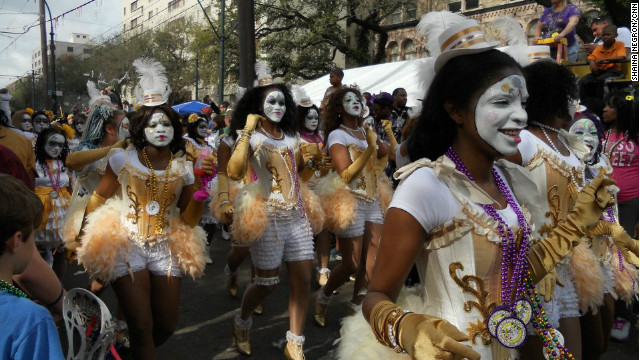
The New Orleans Baby Doll Ladies march in the Zulu parade during Mardi Gras 2012


A modern celebration of African-American history

CNN) -- The week before Hurricane Katrina hit New Orleans in 2005, Millisia White came back to her native city on a trip for work. She stayed behind to help her family recover and has been home ever since.
There was something she felt she had to do. "When something you are so familiar with is threatened to be lost forever, you cling to what's familiar," said White, who moved back from Atlanta.
For White and her brother, that meant bringing back a century-old New Orleans practice of masking, or masquerading, which was nearly vanishing.
That year, she founded the New Orleans Society of Dance and incorporated into the dance company a cultural legacy series of dance performance that would revive tradition of the Baby Dolls -- with a modern twist.
"We wanted to do something representing this tradition and what it meant and symbolize it in some form."

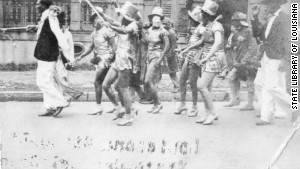
In a photo from the State Library of Louisiana, women wear Baby Doll-style costumes in a 1930s street parade.
The Baby Doll practice started about 1912, when groups of women in New Orleans' red light district poked fun at society's stereotypes of women by marching in street parades dressed as dolls. It grew into a tradition centered on dance and paired with jazz bands of the popular music of the era.
Groups of women embraced the attitude of freedom and the pageantry of the Baby Doll street parades, but their focus grew over the decades. They organized and began serving their community through groups called "social aid and pleasure clubs."
"These were just people who were very much of their community," said Karen Leathem, a historian with the Louisiana State Museum. "They tried to help their neighbors during an era of segregation and limited opportunity for all people of color."
However, by the 1980s and 1990s, only a handful of groups were masking as Baby Dolls.
Several neighborhood groups like the Million Dollar Baby Dolls and the Ernie K-Doe Baby Dolls were active in the new millennium. But by 2005, the Baby Doll practice seemed as if it was about to be forgotten in Katrina's wake.
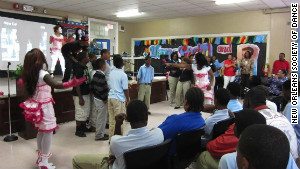
The Baby Doll Ladies with DJ Hektik dance with students at the McDonogh 42 Charter School in
 spring 2011.
"My brother and I decided, we needed a sort of campaign," White remembered. "It all started so we could give something back in our own backyard."
She had heard about the Baby Doll tradition as a child and felt that it was a medium close to her heart. "It's synonymous with dance and with women," she said.
White's revival produced the Baby Doll Ladies, with costumes, face paint, music and dances that are modern takes on the Baby Dolls of the past. Rather than using a live band, her brother DJ Hektik plays mixes of hip-hop and jazz for their choreographed performances.
But White also wanted to bring back the community focus central to the Baby Doll tradition.

Enhanced by Zemanta

Friday, 8 February 2013

Seamstress keeps Carnival costume-making alive!


From the day two dancing puppets named Tan Tan and Saga Boy made their debut on the Savannah stage in Port-of-Spain, not a Carnival has passed without a band that had skirts, pants, frills or capes constructed by Lachmin Rampersad. 

She is the go-to-seamstress from Annandale, Demerara-Mahaica, Guyana, who saves the day for mas bands offering masqueraders more than a slice of lycra as a costume. 

And she’s often at the ready and to the rescue for last-minute stitching tasks and adjustments as she offers bandleaders an efficient production factory that upholds fairly high standards in quality control. But she is not the cheap labour that is in abundance in China. 

Nike, Apple Computer and former US presidential candidate Mitt Romney, have each recently waged battle against allegations of connections with sweatshop labour in China. Contemporary fashion retailers Sean P Diddy Combs and Tommy Hilfiger recently endured damaging headlines around their labels allegedly employing unsafe factories in Honduras and Bangladesh, respectively. 

According to a March 2012 ABC News report, 29 workers were killed in a hazardous factory that produced clothing for Gap and Tommy Hilfiger’s brand. 

Lachmin Rampersad with her employees
 in her sewing factory
 in central Trinidad. photo : SEAN DRAKES
Trinidad’s mas bands, and its leading fashion retailers, who support factories in China with handsome garment construction orders, have avoided such unfavourable affiliation.

According to Rampersad, there isn’t an association for garment construction factories in Trinidad, nor is there a checks and balance system for the remaining factories like hers. But she’s adamant about making suitable provisions, since she was once a stitcher who worked eight-hour shifts. 
No sweat house

“My place is air conditioned,” says Rampersad, “I feel if somebody is not comfortable, they cannot work. If there is not proper ventilation, you will start to get tired. It’s a poor way of having people to work.” 

Her nondescript factory site has sat along a busy road in central Trinidad for the last 22 years. Her low-key persona by no means suggests she’s underprepared for hazards. “I’ve never had to deal with those things. I have tanks should water go. If current goes, everybody goes out in the cool until it returns. If current not coming back on, we tell them to go home, unless we have something to stitch by hand.” 

And should there be an emergency, there are four unobstructed exits for her staff of 35 to exit the 40-foot by 60-foot building.

The conveniences offered in most modern offices are staples in her factory. Employees have use of a cooler, microwave and fridge. But the most adored provision is the compassion Rampersad, 59, showers on her staff. 

“I tell the workers if you feel hungry, take a five minutes, go eat, because if you get sick, it’s worse. Sometimes you don’t know if someone didn’t eat at home.”

“Our people are paid properly. After 4 pm, they get time-and-a-half and they get a meal.” 
Continued on Page 5
From Page 4
The transparency around working conditions that Rampersad affords her customers has not exactly deterred clients from taking their business to China. Nonetheless, she is committed to nurturing her community in times when there are fewer and fewer options for young people. 

“Everybody in my factory is over 18. You don’t get young people to come in to work even as apprentices, because of CEPEP and On-the-Job Training (OJT). Nobody wants to learn the garment industry,” laments Rampersad.

“There’s no provision for that. It have (sic) Servol, but they have to pay to go there. People in the poorer bracket, they can’t afford that. You have people who have the passion for it, most of them if they have the passion for it, then I train them. As long as they are willing to do it, we will get there. 

“I have never had to fire nobody. If somebody come into the work and I know they are stressing me out, I say, Lord, you work it out. To fire somebody…I can’t do that.” Her daughter Stacy injects, “They leave at their own will.” 

“And when they gone, (sic),” adds Rampersad, “I say, Lord, thank you for helping with that one.”
Fortified by faith

Rampersad is a traditionalist who takes accountability seriously; she’s also a woman of strong faith. The fourth of five sisters and two brothers, she migrated to Trinidad in 1978 at the age of 25, after just two visits. An introduction that turned romantic inspired her sudden relocation. She was part of a church group. 

“We came across, stayed for two weeks; his father was in the Trinidad group.”

She is referring to Chankalal Rampersad, the dashing truck driver she met on that trip and stayed in contact with via handwritten letters.

In Guyana, she worked as a stitcher. Soon she was designing trousers, shirts and uniforms. Her daily stitching quota was 100 pieces. 

“We did it in parts, somebody would do the pocket, somebody would sew up the sides. We used to work for $25 a day.” 

That rate was bumped to $30 after one year of service. Rampersad credits her versatility and for quickly landing a position with Spartan industries in Trinidad.

“After I had my first child, I decide to stay home,” she explains.

Her husband “wasn’t getting enough work,” so she bought a sewing machine, and an entrepreneur was born. She went door to door seeking newborns to clothe with baby vests (kazacks) made of jersey. “One neighbour would order a dozen. Money was small then, I put a small markup. Sometimes I could sew 100 in eight hours,” recalls Rampersad. 

While other women collected handbags and shoes, she fancied sewing machines, and acquired six in five years.

She hired and trained her first employee six months into her new home-business; just stitching baby vests. 

“When she go home (sic), I used the machine in the evening.” 

The drawing room was at capacity with ten machines by the time they broke ground on a neighbouring lot. Banks wouldn’t give her a loan back then, so she used savings of just under $20,000 to build a simple 20-foot x 40-foot concrete brick production space. Word-of-mouth served to build the Rampersad’s small business, and continues to be the only form of advertising their business relies on.
Crowning glory

Her biggest honour was constructing the spirals and musical notes for costumes by Peter Minshall that appeared in the opening and closing ceremonies of the 1996 Olympic Games. Soon, her clients included Legends, Brian MacFarlane, Alyson Brown. And she’s done “some work for Peter Elias.” 

“I work for Rosalind Gabriel two years now, I do little stuff for Tribe,” adds Rampersad. 

“I work last year for K2K, (on about 50 per cent of the band), but this year they went China.” 

(For accuracy, she did work on a few elements of K2K’s 2013 presentation. By press time, bandleaders did not respond to our request for comment on aspects of manufacturing.)

“If everything goes to China, ten years from now, what will happen to T&T? It’s revenue going out, nothing coming in.” 

Government minimum wage is $12.50 an hour. 

“My staff don’t work for $12.50 an hour, they work for much more than that,” stated Rampersad. “I know quite a few huge factories that went out of business, they had more than 100 employees. Everybody bringing in 40-foot trailer from China.” 

School uniforms are the bread and butter for the remaining garment construction factories, but that work is also going to China.

“After school uniforms, what next?” she wonders. 

Rampersad’s stellar reputation provides steady business for uniform and mas construction, and she isn’t bothered by requests to adjust costumes made in China. She continues to produce baby vests, which retail for $7 each. “Right now I export these to Barbados, Grenada, Guyana and Tobago,” she explained. “My label goes on it. Most of them is (sic) wholesale.” 

While she strives to do her part to create jobs, she prays for government intervention in the form of incentives for mas bands to manufacture more mas locally. The local workforce, she says, “is losing out to the culture. The only thing driving them (mas bands) to China is the cost.” 

SOURCE:Sean Drakes

Enhanced by Zemanta

Thursday, 22 March 2012

Carnival designer to host pre World Party in the Park Popley workshops

LEADING Notting Hill Carnival designer Clary Salandy will soon be in town as part of preparation for this year’s World Party in the Park. Craft education charity The Making has arranged for Trinidad-born Clary to come to Popley to introduce Mas-making or Masquerade to Basingstoke families.

Some of Clary's work.
 Copyright image by Mahogany
 
 Her free Caribbean Carnival workshops will take place at the Popley Spotlight Centre during the Easter and summer half-term holidays. The families will make sculptures and costumes to be worn at the Children’s Parade in Eastrop Park on June 30. Clary said: “Carnival grew out of slavery and protest, and is a legacy passed on to people like me.” Her parents took part in carnivals in Trinidad, and her father before her made carnival costumes when he was young. Today, Clary’s costumes are legendary throughout the world. She continued: “I want to take spectators’ breath away! It’s all about impact and affirmation, bringing the world of imagination to life. It should be awe-inspiring. “I create costumes that have inherent movement, but at the end of the day, the life of the costume belongs to the performer and they should be able to feel that they can do something exciting with it.” Mahogany, the company Clary co-founded, prides itself on passing on Carnival traditions and skills to other artists and particularly to young people through its workshop programme.

 Their award winning collaborations have been featured in the Caribbean, London, Paris, Nice, Sweden, United States and Trinidad and act as a catalyst for bringing together people from culturally diverse backgrounds. *Workshops will take place on April 2 – 4, and from June 5 – 7 at the Spotlight Centre in Popley. They are free but are on first come first served basis, so people will need to get there early to be sure of a place. Children under 12 must be accompanied by an adult.

Source: http://www.basingstokegazette.co.uk/
Enhanced by Zemanta

Tuesday, 31 January 2012

Haiti - Carnival of Les Cayes : Very serious accusations of Mirlande Manigat

Mirlande Manigat has made ​​serious accusations, this weekend on a radio of the capital, on the reasons which led the Government to choose the city of Les Cayes to hold the national carnival, on the mafioso origin of its funding and finally decried the poor quality of our National Carnival, preferring to promote the Carnival of Trinidad ! Surprising statements and accusations from a personality that so far, was respected in the country...

"...I do not like make accusations that I'm not sure Why the carnival in Les Cayes ? Because there is a large-scale money laundering, which is made in Les Cayes, the agent comes by boat, cash [...] why they [the government] makes the carnival in Les Cayes ? This is because of that ! That is not decentralization! [...] Since I was a teenager, I did not go to the Carnival, this is not something that... I was watching the floats. I lived four years in Trinidad, there, it's a 'bèl ti bagay' it is the creativity, is the beauty, this does not prevent people dance and drink, but there are ideas... I do not know the Rio Carnival but people who know both carnivals say that unfortunately there is not enough promotion for the Carnival of Trinidad.

I am not against a Carnival of this type, however, one thing that I notice is that we have decided to do it in Les Cayes, why not in the Gonaïves or in Cap Haitien why Les Cayes ? Does Les Cayes have an infrastructure to organize in such a short time the Carnival ? Above all, what is most important to me is the degree of dissatisfaction of the people of Port-au-Prince..."


Reacting strongly to the accusations, Jean Gabriel Fortuné, the Departmental Delegate of South requires that Mrs. Manigat deny her statement "...I'm surprised really that a personality like Mrs. Manigat, who is respected in the country, makes a sensational statement, but also misleading.

For the truth, I tell you that the Government Martelly-Conille has not yet spend any money in Les Cayes within the framework of Carnival, there are preparations that are made​​, we make them on credit, it is at the expense of Fortuné they are made [...] works are carried out in collaboration with the traders of the city of Les Cayes [...] so we ask to Mrs. Manigat, to deny the statement that she made [...]

If it was this kind of money, Fortuné would not be in there, because it is me who has the habit to denounce this kind of thing for 15 years in the country. So far, the Carnival Committee has not received any money and the funds we have constituted​​, we have constituted​​ them from loan we made with traders, ranging from 20.000 to 200.000 gourdes, and even that money is not spent, because the committee is not yet fully structured..."

Enhanced by Zemanta

Tuesday, 18 January 2011

3 CANAL : JAM-IT!


As the 19th century drew to an end the ruling classes saw a rise in acts of aggression and sexual profanity, in the portrayals of African masqueraders. The period became known as the ‘Jamette Carnivals’.

The word ‘Jamette’ comes from the French word ‘diametre’ and referred to the class of people ‘below the diameter of respectability’ ...the upper classes were distancing themselves from the lower classes...to emphasize the immorality...and hence the inferiority of the Africans. ( Liverpool Hollis)

During the 19th century Africans had to exist in deplorable living conditions. These conditions were witnessed in their most extreme form in the barrack yards of the capital. Due to these conditions the barrack yards were the epicentres for crime, prostitution, and other forms of lawlessness. The barrack yards being the homes of Trinidad’s Afro-Trinidadian lower classes were also the bastions of African cultural resistance and identity.

Out of theses barrack yards came some of the most iconic characters and symbols of defiance that Trinidad’s carnival has ever produced. As the century came to an end these characters, and ritual practitioners would directly confront the laws and institutions of the establishment that seemed to exist solely to erase their cultural identity.

From the poverty ridden, crime infested environments of the barrack yards the Jamette emerged. If the stick fighter was the warrior King of the Kalenda, and the Cannes Brulees procession, and the male personification of African defiance, the ‘Jamette’ was the Queen, her very physical presence was the personification of colonial defiance.

Read more: MASSASSINATION.: 3 CANAL : JAM-IT! http://massassination.blogspot.com/2011/01/3-canal-jam-it.html#ixzz1BQvB8uVX
Under Creative Commons License: Attribution

Enhanced by Zemanta

Friday, 24 December 2010

227 years of Christmas into Carnival

ASTRIDE: Actor Nigel Scott on horseback plays the part of Governor Sanford Freeling
Trinidadians have always loved their mas and this is what Captain Baker found out when, high on the success of the previous year, he again tried to stop the Canboulay procession in 1881. And while a lot is known about this period in our Carnival history, Sir Sanford Freeling is a lesser known figure.
This was brought to light however at the launch of Carnival 2011 recently at the Queen’s Park Savannah in Port of Spain. There were a lot of police present but unlike the events of 1880 and 1881, the police were there to make sure everything went okay.
John Cowley, in his Carnival, Canboulay and Calypso, notes that “Canboulay was seen as an integral part of the Carnival”.
The recent Carnival launch took place under blue skies and hot sun, Perfect weather for a launch in the outdoors and the kind of weather, no doubt, that would have been immediately familiar to “Captain” Arthur Wybrow Baker (he really was only a Lieutenant). Baker, an Englishman, had arrived in Trinidad in 1877 and he did not like Carnival or Canboulay. 
Cowley reports that in 1880, “police were stationed judiciously on foot throughout Port of Spain. Baker controlled the streets on horseback, assisted by sub-Inspector Concannon and Sergeant Major Brierley. On commencement of Canboulay they interposed at each stickband conflict and forced the surrender of flambeaux, drums and sticks”.
Into all this, later on the year 1880, November to be exact, came Sir Sanford Freeling to take up the post of Governor of the then colony. Baker had already made up this mind that Canboulay would not happen in 1881 and he went to Freeling with the request to stop it, which he refused. According to Cowley a notice was posted in Port of Spain and environs which stated, “Captain Baker demanded from our just and noble governor, Sir Sanford Freeling, his authority to prevent the night of Canboulay, but our Excellency refused”. Baker thought he would have been able to suppress the Canboulay as easily has he’d done the previous year, what he did not know was that the stickbands had organised to oppose him and the fights that took place on the night of February 27 and early morning February 28 are now in the pages of history and on the city streets through the now annual Canboulay renactment on Jouvert morning.
It was up to Freeling to restore order and he had no intention of stopping Carnival. What he did was to confine the police to their barracks and allowed the population to continue with their Carnival. He also made a speech to the masqueraders giving them the assurance he was on their side and had no intention of stopping their pleasure. 
This speech was heard once again on December 5 at the launch of Carnival 2011 themed “Back To De Savannah”. At the launch, the role of Freeling was revived by well-known local thespian Nigel Scott. It shows that while Freeling had been in the country less than a year, he understood the town of which he was Governor.
Governor Sanford Freeling’s Speech:

My dear friends, I have come down this afternoon to have a little talk with you. I wish to tell you that it is entirely a misconception on your part, to think that there is any desire on the part of the Government to stop your amusement. I know everybody at times likes to amuse themselves; I have no objection to amuse myself whenever I have an opportunity. I had no idea what your masquerade was like. If I had known you should have had no cause for disaffection. There has been entirely a misconception on all sides, for the only interference was the fear of fire; I thought that the carrying of torches at this time might be attended with danger, and I was anxious to guard against it. That was the only objection; it was the fear of fire and nothing more. The Government had no other objection. I did not know you attached so much importance to your masquerade. I also wish to tell you how proud I am to be Governor of your island; I had a desire to come here and know you, that I could write and tell Her Majesty the Queen that no more loyal and peaceful subjects inhabit the other colonies like Trinidad. I am come down this afternoon for I felt I could have confidence in your loyalty. I have trusted myself among you, and I would not hesitate to bring my wife and my children on such an occasion – I feel they would be very safe, if your decision be to carry out your masquerade in a peaceful manner. I am willing to allow you every indulgence. You can enjoy yourself for these two days and I will give you the town for your masquerade, if you promise me not to make any disturbance, or break the law. I shall give orders that the constabulary shall not molest or interfere with you, if you keep within the law. I trust that you will continue to enjoy yourselves without any disturbance. There shall be no interference with your masquerade. Thank you. 

There’s just one more point to be made about Trinis and our Christmas into Carnival celebrations. Cowley says that there was no annual Carnival during the Spanish rule but when the French Creole planters and their slaves came after the Cedula of Population in 1783 and he offers this description from Pierre-Gustave-Louis Borde:

The pleasures of meals at the dining table and picnics were added to those of music and dancing. There followed nothing but concerts and balls. There were lunches and dinners, hunting parties and expeditions on the river, as well as Carnival which lasted from Christmas time until Ash Wednesday. It was nothing but a long period of feasts and pleasures. 

We’ve been partying like this, ladies and gentlemen, for roughly 227 years and that’s one thing about Trinidad that’s not likely to change any time soon. A very Merry Christmas and Happy Carnival to all.

SOURCE
Enhanced by Zemanta

Friday, 1 October 2010

Spice launches C2K11 collection

A model showcases the haute Couture Frontline from the cluster
From Paris With Love.
PHOTO: Courtesy Spice Carnival Band
The countdown to Carnival 2K11 is on and mas bands are busy preparing for what many consider to be The greatest show on earth. Spice Carnival band is no exception. Known on the street as the band with the attractive women, Spice made its Carnival debut in 2009 and already has quite a number of successes under its belt. Last year the large band scored big, capturing the King of Carnival crown, portrayed by seasoned masquerader Curtis Eustace, third place in Downtown Carnival and the title for the Most Colourful Band, and fifth place in the Parade of The Bands and the title for Most Creative Band. In its second year, Spice also managed to triple its number of masqueraders from 800 to 2,500, and according to band officials, that number is expected to increase by another 500 when Carnival rolls around again in March. What’s the secret? Spice executive member Jean-Paul Pouchet says it’s all about giving masqueraders “the greatest experience on the road.”
Outside the box
Pouchet says band members are always thinking outside the box and will, for the first time, offer masqueraders clusters of sections, instead of individual sections. Each cluster, he says, will be under four themes—Diamonds Are Forever, Ribbons Of Loyalty, Out of the Vineyards and From Paris With Love. The band’s presentation is titled The Signature Collection. He explains that introducing the clusters give masqueraders the opportunity to be close to friends who may prefer a different costume. “The section line up every year is always a very big point for the masqueraders, as they want to know where their section is from their friends. If you are in the same cluster, you won’t be that far away from each other,” he says. He says Spice will also launch its Signature Line, which will feature five more elaborate costumes from selected sections.
Quality product
Priding itself on offering a quality product for customers, Pouchet says value for money is always on the band’s front burner. Describing Spice as a “family oriented band” The Petit Valley resident says, “We spare no expense in the production of our costumes. We treat our masqueraders like family. When you become a “spicequerader” you become part of the Spice family.” Also new is the band’s catalogue, which Pouchet says is akin to a magazine and seeks to educate masqueraders in general and visitors in particular about Trinidad’s Carnival. “We are the first band to do a 360 tour of our show room. People can focus on what they want and even foreigners can get that feel of coming to the show room without being there physically.” Meanwhile band leader Anya Elias articulates that Spice offers “a totally all-inclusive experience.” Elias says the masquerader playing with Spice need not worry about anything else but having a good time. Food, an open premium bar and security will be taken care of.
Spice 2011 presentation
Diamonds Are Forever:

• Jubilee
• Sha Jahaan
• Canary Frost
Ribbons of Royalty:
• Carnival Vicuna
• Dupioni
• Peruvian Splendor
Out of the Vineyard:
• Bordeaux Beauty
• Vines of Syrah
• Tuscany Sunset
From Paris With Love:
• Haute Couture
• Vogue
• Tres Chic
Walk of Fame
(An individual section)


SOURCE
Enhanced by Zemanta

Sunday, 31 January 2010

MAS JUMBIES RELEASE THEIR LAST SECTION: Pai Banan

The Pai Banan is an extinct Masque that died out by the early 1900's. it was popular in Trinidad's rural districts, where they would appear J'Ouvert morning in small groups. The costume was simple and consisted of bits of cloth and banana leaves. On their heads was a turban or a fula that held cow horns or antennae.  The face was covered by a papier-mâché mask, similar to those of the Pierrot Granade. They went around frightening people in the early hours of J'ouvert morning.
The MAS Jumbies version presents a more sinister visage of this traditional masque.
The Costume
1)Unique light-weight head mask, made with black crocus material, cloth and plastic strips. The see-through facemask has eye holes and is enhanced with a chrome silver diamond detail chain and two black horns with gold band details. Some strips fall to the ankle (can be cut).
2) Natural Pod Necklace (adjustable).
3) Black cloth (ankle length) sarong for both men & women.
4) Silver Bell ankle or wrist band.
5) Black vest for the women.
6) Mandatory Black Body paint.
TT$400.00/ US$65.00

Reblog this post [with Zemanta]

MASSASSINATION. Headline.

LinkWithin

Related Posts Plugin for WordPress, Blogger...