Search Mas Republic

Showing posts with label Trinidad and Tobago. Show all posts

Saturday, 16 February 2013

BABY DOLLS OF NEW ORLEANS

In Trinidad and Tobago Carnival there is a traditional  mas character called 'baby doll'. Born of of the carnivals of the 1930's the baby doll masquerader will walk around with a doll, that represented an illegitimate child and accuse men on the street of being the babies father and demand money.

I just came across an article on a character in the united States that pre dates Trinidad's character of the 1930's also called 'Baby Doll' very interesting indeed.
check it out.
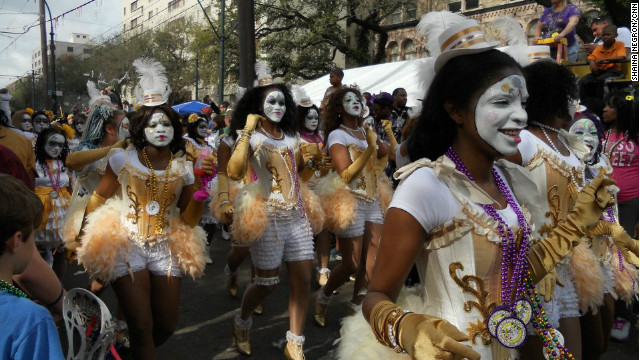
The New Orleans Baby Doll Ladies march in the Zulu parade during Mardi Gras 2012


A modern celebration of African-American history

CNN) -- The week before Hurricane Katrina hit New Orleans in 2005, Millisia White came back to her native city on a trip for work. She stayed behind to help her family recover and has been home ever since.
There was something she felt she had to do. "When something you are so familiar with is threatened to be lost forever, you cling to what's familiar," said White, who moved back from Atlanta.
For White and her brother, that meant bringing back a century-old New Orleans practice of masking, or masquerading, which was nearly vanishing.
That year, she founded the New Orleans Society of Dance and incorporated into the dance company a cultural legacy series of dance performance that would revive tradition of the Baby Dolls -- with a modern twist.
"We wanted to do something representing this tradition and what it meant and symbolize it in some form."
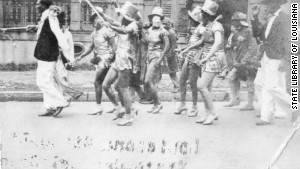
In a photo from the State Library of Louisiana, women wear Baby Doll-style costumes in a 1930s street parade.
The Baby Doll practice started about 1912, when groups of women in New Orleans' red light district poked fun at society's stereotypes of women by marching in street parades dressed as dolls. It grew into a tradition centered on dance and paired with jazz bands of the popular music of the era.
Groups of women embraced the attitude of freedom and the pageantry of the Baby Doll street parades, but their focus grew over the decades. They organized and began serving their community through groups called "social aid and pleasure clubs."
"These were just people who were very much of their community," said Karen Leathem, a historian with the Louisiana State Museum. "They tried to help their neighbors during an era of segregation and limited opportunity for all people of color."
However, by the 1980s and 1990s, only a handful of groups were masking as Baby Dolls.
Several neighborhood groups like the Million Dollar Baby Dolls and the Ernie K-Doe Baby Dolls were active in the new millennium. But by 2005, the Baby Doll practice seemed as if it was about to be forgotten in Katrina's wake.
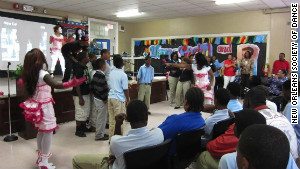
The Baby Doll Ladies with DJ Hektik dance with students at the McDonogh 42 Charter School in
 spring 2011.
"My brother and I decided, we needed a sort of campaign," White remembered. "It all started so we could give something back in our own backyard."
She had heard about the Baby Doll tradition as a child and felt that it was a medium close to her heart. "It's synonymous with dance and with women," she said.
White's revival produced the Baby Doll Ladies, with costumes, face paint, music and dances that are modern takes on the Baby Dolls of the past. Rather than using a live band, her brother DJ Hektik plays mixes of hip-hop and jazz for their choreographed performances.
But White also wanted to bring back the community focus central to the Baby Doll tradition.

Enhanced by Zemanta

Saturday, 28 January 2012

Mac Farlane's SANCTIFICATION at the stadium on carnival Monday.

Brian Mac Farlane will be putting on a theatrical  presentation of Sanctification at the national stadium in Port of Spain on Carnival Monday 20th February 2012.
 An on-line statement on Face book to loyal masquerades read,
UWI art students work on the camp.
"TO ALL LOYAL MASQUERADERS:Mac Farlane Carnival would be taking our Mas to a different level in 2012. Together with you we plan to transform the Mac Farlane Monday Mas experience into something Magnificent.In addition to being on the road in full costume and revelling through the streets of Port Of Spain, we will be presenting ourselves in our very own space.Free of Hassel,Full of Collage, Be part of this powerful Theatrical Presentation of Mas.
The Pre Show starts at 6:30 with Rosalind Gabriel's Children Presentation followed by Shadow ,David Rudder,Silver Stars and Patrice Roberts. At 7:30pm we Mac Farlanes will cross the Stage with Kees Dieffenthaller and Tony Prescott performing where all Masqueraders will get a chance to play themselves for 45mins - 1Hour. We Look Forward to YOU being apart of this experience with US."
The section "Salacious"- SANCTIFICATION

Enhanced by Zemanta

Thursday, 3 November 2011

Mac Farlane in search of ‘Sanctification’

Crime, violence and the state of emergency were the inspiration behind Brian Mac Farlane’s 2012 presentation, Sanctification...In Search of.
Known for his lavish launches over the years, Mac Farlane, who this year opted for the confines of his Rosalino Street, Woodbrook mas camp for the launch of his 2012 presentation, didn’t skimp on theatrics, and in true Mac Farlane style, the five-time band of the year winner gave patrons a vivid representation of what next year’s presentation represents.

Mac Farlane held the attention of patrons for a little over half an hour as he dramatically unfolded Sanctification and vividly depicting good versus evil. Mac Farlane, emerged from a hole in the stage, and appeared as if he was emerging from the centre of the earth. And after tugging and fighting with a deathly and wicked looking character representing evil and trying to yearn towards a figure in white representing good, Mac Farlane was eventually “set free,” and was able to unveil the ten sections of Sanctification – “Aphotic” (Having no light, Darkness), “Luxuria” (Self Indulgent, Sexual Desire, Lust – One of the Deadly Sins), “Annihilation” (Destruction of Life, War, Murder); “Hades” (Ruler of the Underworld); “Salacious” (Lustful, Obscene, Grossly Indecent; “Lecherous” (Erotically Suggestive, Inciting to Lust); “Sheol” (Departed Spirits, Lost Souls), “Benevolence” (Goodwill, Desire to do Good); “Jubilation” (Celebration, Joy or Exultation) and “Patrioteer” (Flag Waver, Lover of Country, Loyalist). 
Brian Mac Farlane emerges from a hole in the middle of the stage
during a theatrical presentation
 which was part of the launch of his 2012 Carnival presentation
 Sanctification...
In Search Of held on Sunday at his mas camp,
 Rosalino Street, Woodbrook.


Unlike other Carnival bands, Mac Farlane’s launch did not feature models presenting costumes and patrons had to settle for sketches of characters in red, white and black.

Mac Farlane, who said he almost didn’t bring out a band for 2012, said next year, his revellers will be clothed in cotton as he has done away with all the fancy materials and trimmings. The band will feature the colours of Trinidad and Tobago’s national flag, red, white and black, with the red representing blood, black, the darkness and white, unity.

Sanctification...In Search Of is the final installment of a trilogy of presentations which began in 2010 with his presentation Resurrection and continued this year with Humanity Circle of Life.
source: newsday
Enhanced by Zemanta

Saturday, 6 August 2011

Golden era of Mas

Farewell: Anthony Chow Lin On, right, relatives and friends carry the casket of his father
 Alwin Chow Lin On at St Finbar's RC Church, Diego Martin yesterday.
In the eulogy to his father Alwin “Chow Lee” Chow Lin On yesterday at St Finbar’s RC Church, Morne Coco Road, Diego Martin, Anthony Chow Lin On (Chinese Laundry) said Chow Lee’s personal dream was to one day go back to the golden era of Sally (Harold Saldenah), (George) Bailey, (Peter) Minshall and others, who were his heroes and influences.

He spoke of his father keeping many notes and in later years writing his experiences and thoughts about pan and Mas, every note ending with Sankofa, almost like a call to arms, a revolution.

The Sankofa is a symbol which represents the idea that one must take from the past what is good and bring it into the present in order to make positive progress through the benevolent use of knowledge. Sankofa belongs to the Akan language spoken by the Akan people, ethnic groups of Ghana and Côte d’Ivoire.

He then explained how his dad felt about the golden era of Mas through one of his notes, quoting: “Trinidad and Tobago must become the vanguard of our Carnival culture, with the Carnival City where you can see all the great costumes like “Man Crab”, “The hat I had for Christmas was too Big”, “The Cray Fish”, “Bachac Pushing Ganja”, “Beauty in Perpetuity” and “The Sacred and the Profane” all dancing at the Carnival City and also displayed at the museum all year round....wouldn’t that be great?”

Chow Lee was born and grew up in Sangre Grande as a typical shop keeper’s son, then moved to Port-of-Spain where he attended St Mary’s College but left after fourth form to work with his uncle George Pantin at his accounting firm.

After a few years Chow Lee returned to Sangre Grande to run the family business and that is where he got his early experience in Mas, stick fighting, and steelband. He was the founding member of Cordettes Steelband in 1962, and at the funeral, a number of ex-Cordettes members reunited to play a soothing rendition of Baron’s “Words” during which, a number of people quietly wept. Chow Lee even went on to be a past Pan Trinbago president.

His love for Mas began with Elsie and Stephen Lee Heung’s “Paradise Lost” in 1976. It was the first time he got to work on costumes and he came out with a wealth of knowledge and experience working with Peter Minshall. A year later came the birth of Zodiac of which Chow Lee was a part, organised to produce Minshall’s designs. That they did for four years before handing over the band to Minshall.

Chow Lee has been known to bring Minshall’s designs to life through his clever engineering of the structures of the queen and king costumes, many of them going on the take the national titles.

He also had a great knowledge of the concept of fibreglass back packs and, drawing on his as well woodworking and carving skills he also manufactured costumes locally, as well as for Mas in London.

Then there was his restaurant businesses Char B Que and Atlantis where he exposed his culinary skills but, said Anthony, his significant achievement was to the art of Mas. Among the personalities who attended the funeral service were Peter Samuel, Pelham Goddard, Dr Bernard Picou, George and Joey Ng Wai, Howard Chin Lee, Johnny Soong, Canute Spencer, Frank Martineau, Earl Crosby, Rachel Price, Earl Patterson and John Humphrey.

By Joan Rampersad Saturday, August 6 2011
Enhanced by Zemanta

Sunday, 19 June 2011

COCOYEA Presents: Glitz and Glam: Notting Hill Carnival 2011.

Cocoyea Launches there N.H.C. 2011 theme 'Glitz & Glam' tonight, and from the name it sounds like its going to be a sparkly event.
What are you doing this evening?

Enhanced by Zemanta

Friday, 20 May 2011

UNSTOPPABLE: Culture Unleashed. The Addicted Mas Section for N.H.C 2011


The Addicted mas section presents 'Unstoppable, Culture Unleashed'.
This video clip highlights the journey carnival culture has taken from the West coasts of Africa, to the Barrack yards and streets of Trinidad and Tobago, to the streets of Notting Hill and Ladbroke Grove West London , England.
It also gives just a glimpse of what West Indians faced before Carnival was introduced to the British society.

From Africa, to slave ships, to Emancipation.
From Immigration, to Social Rejection, and open aggression.
A CULTURE IS UNLEASHED
From Police oppression, to cultural proliferation.
Carnival culture is...
UNSTOPPABL

Enhanced by Zemanta

Sunday, 6 February 2011

Irvin McWilliams: ‘Localising the mas’ 32 spectacular presentations

Legendary Band Leaders of Yesteryear
We continue our series that takes a look back at the contributions to our Carnival art form of the famous large band leaders from around 1955, the first year of the official Band of the Year competition.  For the purpose of this series we take a look at that era following World War II when designers were able to and began to more widely use their creativity and artistry to portray mainly tangible and non-abstract costumes that would transform our streets into a thematic visual spectacle of colour and living theatre.

Irvin McWilliams (1920-2007)
Mas legend Irvin “Mac” McWilliams, unlike the legends we have featured previously, Harold Saldenah (1925-1985) and George Bailey (1935-1970), lived to a relatively advanced age of 87 (1920-2007).
During his band producing years from 1956 to 1988 he provided T&T with some 32 spectacular presentations, many of which were based on themes of Trinidad and Tobago, its history and its culture.
The first of such local-themed bands was in 1961 Hail La Trinite and the last Stay up Trinbago in 1988. Such presentations one might say were learning tools for Trinbagonians as our folklore and culture were depicted through the vivid imagination of another legendary mas man adept at portraying things local and who was credited as being the first to present a totally local theme on the streets of T&T in his category.
While the title of Band of the Year eluded him for many years it was only until 1971, with the belief that “within our own shores there is untapped material for magnificent mas,” and his presentation Wonders of Buccoo Reef that he finally won the judges approval for the prestigious prize.  Confident in localising his themes he again captured the title the following year with the indigenous Anancy Story and capped off his third trophy in 1978 with the band entitled Know yuh Country.  This was a 3,500-member kaleidoscope of Trinbagonian cultural education described as “a folk festival…in the medium of mas with sections such as Pointe-à-Pierre Oil, Arima Dial, Caroni Bird Sanctuary, and Chaconia Gold Awards had their impact multiplied by the sheer number of costumed revellers. 
Portrayal of Buccoo Reef which won in 1971
“I won’t mind if other mas men do better than me, but it is essential that citizens know the things that make up their islands.”  In 1974 he ventured further afield regionally with his presentation Somewhere in the Caribbean, with costumes and sections including “Jamaican Ackee,” “Grenadian Nutmegs” and “Barbados Flying Fish.”  His bands won the People’s Choice Award on five occasions (1971, 1972, 1977, 1978, 1980) with an increasing number of female masqueraders.  Buccoo Reef also captured the King of the Bands title.  His King Albert Moore also captured the coveted title in 1965, 1968 and 1969, the latter portraying the immensely popular ‘Man in the Moon’.
Especially popular in the 1970s and early 80s, McWilliams was described as a simple and modest man of the people:  “I enjoy mas…I enjoy producing things people like and can play in…I get a kick out of it and as long as I can break even, I’m easy.” He was the first bandleader to use multiple mas camps to assemble costumes in their large numbers as bands grew, and was the first to start selling off costumes if registrants did not collect them on time. Irvin “Mac” McWilliams was awarded the 1971 Trinidad and Tobago Humming Bird Medal Silver for his contributions to Carnival development.
McWilliams Band of the Year Titles:
1971 Wonders of Buccoo Reef;
1972 Anancy Story;
1978 Know Your Country Carnival presentations: Click Here to Share
1956 King David and the Ammonites;
1957 Ten Commandments;
1958 Rulers of Persia;
1959 Feast of Belshazzar.;
1960 The Grandeur That Was Rome;
1961 Hail La Trinity;
 1962 Tribute to India;
1963 Festival of Mexico;
1964 Monarchs of the Nile;
1965 She and the Tibetans;
1966 Effigies of the Gods;
1968 Conquerors of Niniveh;
1969 Realms of the Kings;
1970 One Day in Persia;
1971 The Wonders of Buccoo Reef;
1972 Our Anancy Stories;
1973 Mama Look Ah Mas;
1974 Somewhere in the Caribbean;
1975 Root of All Evil;
1976 Toute Monde Ca Danse;
1977 Season Greetings;
1978 Know Yuh Country;
1979 Our Famous Recipes;
1980 The Rains Came;
1981 Among My Souvenirs;
1982 Dance Zulu Dance;
1983 We Money;
1984 A Woman's World;
1985 The Days of Moses;
1986 Mas Trinidad Style;
1987 The Wedding of Montezuma;
1988 Stay up Trinbago.
source
Enhanced by Zemanta

Tuesday, 18 January 2011

3 CANAL : JAM-IT!


As the 19th century drew to an end the ruling classes saw a rise in acts of aggression and sexual profanity, in the portrayals of African masqueraders. The period became known as the ‘Jamette Carnivals’.

The word ‘Jamette’ comes from the French word ‘diametre’ and referred to the class of people ‘below the diameter of respectability’ ...the upper classes were distancing themselves from the lower classes...to emphasize the immorality...and hence the inferiority of the Africans. ( Liverpool Hollis)

During the 19th century Africans had to exist in deplorable living conditions. These conditions were witnessed in their most extreme form in the barrack yards of the capital. Due to these conditions the barrack yards were the epicentres for crime, prostitution, and other forms of lawlessness. The barrack yards being the homes of Trinidad’s Afro-Trinidadian lower classes were also the bastions of African cultural resistance and identity.

Out of theses barrack yards came some of the most iconic characters and symbols of defiance that Trinidad’s carnival has ever produced. As the century came to an end these characters, and ritual practitioners would directly confront the laws and institutions of the establishment that seemed to exist solely to erase their cultural identity.

From the poverty ridden, crime infested environments of the barrack yards the Jamette emerged. If the stick fighter was the warrior King of the Kalenda, and the Cannes Brulees procession, and the male personification of African defiance, the ‘Jamette’ was the Queen, her very physical presence was the personification of colonial defiance.

Read more: MASSASSINATION.: 3 CANAL : JAM-IT! http://massassination.blogspot.com/2011/01/3-canal-jam-it.html#ixzz1BQvB8uVX
Under Creative Commons License: Attribution

Enhanced by Zemanta

Sunday, 9 January 2011

Gypsy to make stick fighting a sport

Stick fighter Moses Ralf, left, shows his skills
as he attacks Henderson Marcano in the gayelle.
  Unable to resist an extempo challenge, Arts and Multiculturalism Minister Winston “Gypsy” Peters clenched the microphone to the delight of a crowd gathered at Kings Wharf, San Fernando on Friday night. Firing back witty responses to calypsonian Neil “Abelele” Baptiste’s lyrics, Peters stole the spotlight, if just for a few minutes, at the Small Money and Associates Carnival Band launch.
Peters made an impromptu visit to the event after officially attending the launch of the national stick fighting competition held within sight of the band launch. In an interview in the gayelle (stick fighting ring), Peters said he wants to develop the artform into a real sport. Peters said, “Stick fighting is something that is dear to my heart.  I was raised on stick fighting, raised in the gayelle. I will like to see stick fighting as a real sport where people would have gears and stuff and take it to the next level.”
Although the artform seems to be dying, he said the number of young people seen at the event indicates that it might be resuscitating.  “We must not let these artforms die,” he added. Despite criticisms regarding his decision to create a People’s Band this year, he said, “The People’s band will be the biggest band for Carnival. The People’s band will have stick fighting.  Stick fighters everywhere come into the People’s band!”
The minister said he wished there could be more creativity in Carnival costumes instead of the usual bikinis and beads. “You cannot distinguish between a Trinidadian band and a Brazilian band.  I wish they would become more creative and play the mas that we know to play.  Let us go back to portrayals,” he said.  Businessman Steve Grant, who has been promoting the artform for the past 30 years, agreed it was dying.  However, he said they were in the process of trying to revitalise it.  He said competitions would be held every Friday and Saturday until Carnival Tuesday.  Several people, young and old, had gathered around the gayelle to see the stick fighters in action.

Sascha Wilson


Enhanced by Zemanta

Friday, 24 December 2010

227 years of Christmas into Carnival

ASTRIDE: Actor Nigel Scott on horseback plays the part of Governor Sanford Freeling
Trinidadians have always loved their mas and this is what Captain Baker found out when, high on the success of the previous year, he again tried to stop the Canboulay procession in 1881. And while a lot is known about this period in our Carnival history, Sir Sanford Freeling is a lesser known figure.
This was brought to light however at the launch of Carnival 2011 recently at the Queen’s Park Savannah in Port of Spain. There were a lot of police present but unlike the events of 1880 and 1881, the police were there to make sure everything went okay.
John Cowley, in his Carnival, Canboulay and Calypso, notes that “Canboulay was seen as an integral part of the Carnival”.
The recent Carnival launch took place under blue skies and hot sun, Perfect weather for a launch in the outdoors and the kind of weather, no doubt, that would have been immediately familiar to “Captain” Arthur Wybrow Baker (he really was only a Lieutenant). Baker, an Englishman, had arrived in Trinidad in 1877 and he did not like Carnival or Canboulay. 
Cowley reports that in 1880, “police were stationed judiciously on foot throughout Port of Spain. Baker controlled the streets on horseback, assisted by sub-Inspector Concannon and Sergeant Major Brierley. On commencement of Canboulay they interposed at each stickband conflict and forced the surrender of flambeaux, drums and sticks”.
Into all this, later on the year 1880, November to be exact, came Sir Sanford Freeling to take up the post of Governor of the then colony. Baker had already made up this mind that Canboulay would not happen in 1881 and he went to Freeling with the request to stop it, which he refused. According to Cowley a notice was posted in Port of Spain and environs which stated, “Captain Baker demanded from our just and noble governor, Sir Sanford Freeling, his authority to prevent the night of Canboulay, but our Excellency refused”. Baker thought he would have been able to suppress the Canboulay as easily has he’d done the previous year, what he did not know was that the stickbands had organised to oppose him and the fights that took place on the night of February 27 and early morning February 28 are now in the pages of history and on the city streets through the now annual Canboulay renactment on Jouvert morning.
It was up to Freeling to restore order and he had no intention of stopping Carnival. What he did was to confine the police to their barracks and allowed the population to continue with their Carnival. He also made a speech to the masqueraders giving them the assurance he was on their side and had no intention of stopping their pleasure. 
This speech was heard once again on December 5 at the launch of Carnival 2011 themed “Back To De Savannah”. At the launch, the role of Freeling was revived by well-known local thespian Nigel Scott. It shows that while Freeling had been in the country less than a year, he understood the town of which he was Governor.
Governor Sanford Freeling’s Speech:

My dear friends, I have come down this afternoon to have a little talk with you. I wish to tell you that it is entirely a misconception on your part, to think that there is any desire on the part of the Government to stop your amusement. I know everybody at times likes to amuse themselves; I have no objection to amuse myself whenever I have an opportunity. I had no idea what your masquerade was like. If I had known you should have had no cause for disaffection. There has been entirely a misconception on all sides, for the only interference was the fear of fire; I thought that the carrying of torches at this time might be attended with danger, and I was anxious to guard against it. That was the only objection; it was the fear of fire and nothing more. The Government had no other objection. I did not know you attached so much importance to your masquerade. I also wish to tell you how proud I am to be Governor of your island; I had a desire to come here and know you, that I could write and tell Her Majesty the Queen that no more loyal and peaceful subjects inhabit the other colonies like Trinidad. I am come down this afternoon for I felt I could have confidence in your loyalty. I have trusted myself among you, and I would not hesitate to bring my wife and my children on such an occasion – I feel they would be very safe, if your decision be to carry out your masquerade in a peaceful manner. I am willing to allow you every indulgence. You can enjoy yourself for these two days and I will give you the town for your masquerade, if you promise me not to make any disturbance, or break the law. I shall give orders that the constabulary shall not molest or interfere with you, if you keep within the law. I trust that you will continue to enjoy yourselves without any disturbance. There shall be no interference with your masquerade. Thank you. 

There’s just one more point to be made about Trinis and our Christmas into Carnival celebrations. Cowley says that there was no annual Carnival during the Spanish rule but when the French Creole planters and their slaves came after the Cedula of Population in 1783 and he offers this description from Pierre-Gustave-Louis Borde:

The pleasures of meals at the dining table and picnics were added to those of music and dancing. There followed nothing but concerts and balls. There were lunches and dinners, hunting parties and expeditions on the river, as well as Carnival which lasted from Christmas time until Ash Wednesday. It was nothing but a long period of feasts and pleasures. 

We’ve been partying like this, ladies and gentlemen, for roughly 227 years and that’s one thing about Trinidad that’s not likely to change any time soon. A very Merry Christmas and Happy Carnival to all.

SOURCE
Enhanced by Zemanta

Monday, 13 December 2010

Carnival launch described as the best ever

taking the lead: Minister of the Arts and Multiculturalism Winston "Gypsy" Peters
 led by example as he paraded in front of the traditional characters.
The official launch of Carnival 2011 came off with great fanfare and in glorious sunshine at the Queen’s Park Savannah, Port of Spain on Sunday.
A production of the National Carnival Commission, the event was billed as Trinidad and Tobago The Home of Carnival…Back in D Savannah.
It featured a parade of traditional Carnival characters by various regional Carnival committees which showcased “real” Carnival costumes such as the Bookman, Pierrot Grenade, Indians, Fancy Sailors, Dame Lorraine, Baby Doll. Jab Jab, Stick Fighters, Gorillas, Blue Devils, Bats, Midnight Robbers, Surri and Plymouth Warriors.
There was also a parade which featured children and adult mas accompanied by DJs as well as steelband music.
Minister of the Arts and Multiculturalism Winston “Gypsy” Peters led the parade of traditional characters before the official launch.
NCC Chairman Kenny De Silva welcomed the spectators and masqueraders before Minister Winston “Gypsy” Peters addressed the savannah audience which included Minister of National Security Brigadier John Sandy, Chaguanas Mayor Orlando Nagesar and Caricom Ambassador Makandal Dagga.

Prime Minister Kamala Persad-Bissessar entered the savannah during Gypsy’s speech and was immediately called upon to say something to the audience.
The PM welcomed all and challenged the NCC commissioners to make Carnival 2011 the best ever before both she and Gypsy declared Carnival 2011 “opened”.
After this everything turned “ole mas” as people gathered in front the stage did not move for the parade to continue.
Trinidad All Stars tried its best to pull the crow in front the stage with them but was unsuccessful. What followed was a quick passing of costumed individuals. Down the track, behind All Stars, Laventille Rhythm Section had worked those fortunate enough to be on spot to hear them at the precise moment, into a frenzy with some drum cuts that were really special.
On stage the Midnight Robber “ramjayed” as Dil E Nadan prepared to perform. Lead singers Raymond Ramnarine and Derrick Seales had the crowd going with their rendition of several of Machel Montano’s hit songs and their own hits.

Calypso followed with the recently crowned Best Village Queen/second place Junior Calypso Monarch Victoria Cooper, and the reigning Calypso Monarch and Calypso Monarch Queen Kurt Allen and Kizzi Ruiz respectively.
Ruiz hit the spot with "Class Language" and Allen impressed his audience with two very compelling songs in the social commentary category “Where are they Now” and “Give Them a Chance”.
Rikki Jai followed and had the crowd singing along with "Barman (give me a Guinness and puncheon)" and he promised that he had another special potion coming for next season, but it was six-time Soca Monarch Superblue who stole the hearts of the audience as he rolled off “Soca Baptist”, “Ethel” and “To Love Sombody”. The audience could not get enough of him and called him back. He then performed “Get Something and Wave” to the delight of the audience.
Roy Cape All Stars should be commended for the superb musical backing of these artistes. The show continued to climb to a peak with Black Stalin as he performed “Come With It” in which he had the audience singing more than he did, he continued with “Black Man Feeling to Party”.
Shadow created quite a stir as he came on stage with “Feeling The Feeling”. The experience of Roy Cape All Stars cannot be understated as the music supplied was immaculate with clean and clear horn lines.


Gary Cardinez


Enhanced by Zemanta

Tuesday, 16 November 2010

Is there class in Carnival?

Often the celebrity is spotted in IslandPeople mas.
Here, Anya Ayoung Chee, right, parades with a friend.
 Photo: courtesy IslandPeople Mas
The spice of our island is quietly rearing its head. Carnival 2011 is near, and with the emergence of brand new soca music, the conclusion of band launches, and the ongoing hustle to register at mas camps where limited costumes remain, the scorch of the season can be felt. Anxiously, masqueraders from across the world wait with bated breath for that moment in time when all inhibitions will be thrown out the door. Revellers will dance in the street, party on the sidewalk, and drink festively. But the question that remains in the back of many people’s minds is, “Has Carnival been diluted?”
Carnival only for elite?
Over the years, world development, and by extension, the development of human beings, has fostered a whirlwind change in our island’s Carnival industry. The costumes have transformed from lengthy, bulky and heavy, to beads and bikinis, feathers and costumed embellishments, highly reflective of Brazil’s sexual staging of a similar festival. The music, too, has changed, with a greater embrace to popular foreign culture with its hip-hop beats, and even dancehall persuasion.
More than anything else, though, the financial climate of Carnival has changed. A band considered to be “the best to jump with on the road” can cost a masquerader in excess of $3,000, this even as the average man on the street is paid a minimum wage of $10 per hour.
Who then are bandleaders catering to? Is it safe to assume that Carnival is now an elitist party, where only those who can afford the exorbitant cost of a costume from the popular bands, and drink free cocktails at $650 all-inclusive fetes, can truly be a part of the cultural and seasonal landscape of our island?
Lewis denies class targets
While there remain public fetes that still draw large audiences, mainly from the lower echelon of our society, there is no denying that the bulk of Carnival’s engagements target the “haves”. Island People’s Derrick Lewis enlightened the T&T Guardian on how he perceives the ever-evolving event and Carnival-masquerade industry, and why it’s not a matter of class, more than it is the privilege factor. “Class is a factor, but not as big as it is played up to be, and certainly not the defining element.
“I think demographics and psycho graphics are playing a more prominent role than ever before, and choice is driven much of the time by the consumer who is looking for more and more service,” said Lewis. He added, “People are defining their targets much more strategically now. The marketing of a band, or an event has become more sophisticated than in years gone by,” he said, explaining that image and economic brackets were certainly included in modern day marketing layouts within T&T’s Carnival. Lewis, however, disagreed that class was a target that stood alone when it came to today’s event and masquerade-band marketing. “I think that based on the middle class being so big in Trinidad and Tobago, as compared to other places in the Caribbean, class boundaries are not defined here,” said Lewis.
“I think there’s more of a movement among local promoters and bandleaders, to offer a privilege to patrons, most of whom desire greater privileges. “At Islandpeople Mas we have one common target, ‘real’ passionate Carnival people who are looking for a creative, service filled, safe, Carnival experience come 2011.” Lewis said in local society there were people from all walks of life who wanted to be treated like a VIP, and would pay more to be treated as such. He said the words “uptown” and “downtown” that were so loosely used, really weren’t properly defined, and he personally did not believe they should be used in setting marketing targets for events and mas bands.
Polarisation in event promotion
The bandleader and educator agreed that the cost of mas today, as opposed to years gone by, was a big factor as to why some people stayed away from Carnival, and hinted that there certainly had been a movement toward polarisation in the local promotion industry in recent years. He, however insisted that social class was not a contributing factor, adding that privilege was key.
“The value and importance of Carnival of ‘we’ has started to move towards, Carnival of ‘me’,” said Lewis, citing that while the festival began many years ago as a national and cultural engagement, various societal elements, inclusive of crime and development of other ills, had diverted the natural course of the festival. There’s no denying that over the years a shift as taken place. Whether the shift has taken away from, or added to the notion of “the greatest show on earth”, is based on individual perception. One thing is certain though, and that’s the fact that one must be financially secure to engage in most of what’s offered within T&T’s Carnival.


Aba A Luke

Enhanced by Zemanta

MASSASSINATION. Headline.

LinkWithin

Related Posts Plugin for WordPress, Blogger...